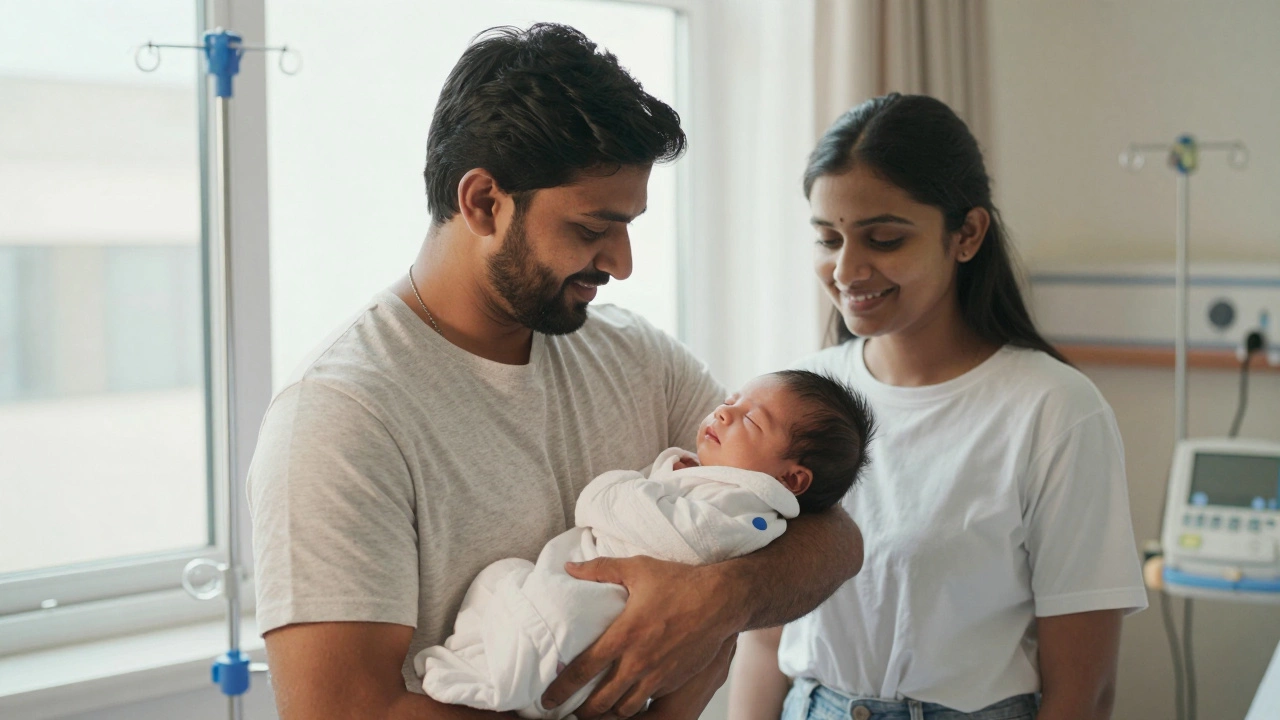
IVF Risk Assessment Calculator
This calculator estimates the relative risk of common outcomes for IVF babies based on parental factors. Data comes from comprehensive studies referenced in the article.
When you hear the word IVF, you might picture lab equipment, hormone shots, or nervous couples waiting for a pregnancy test. But the real question many people whisper - or even ask outright - is: Are IVF babies normal?
It’s a fair question. After all, IVF means conception happens outside the body. Eggs and sperm are mixed in a dish. Embryos are watched under microscopes. One is placed back into the uterus. It sounds like science fiction. So how could the result be ordinary?
The short answer? Yes, IVF babies are normal. Not just in the way they look or talk, but in how they grow, learn, and live. They’re not more likely to have birth defects, developmental delays, or chronic illnesses than children conceived naturally. And they grow up to be just as healthy as anyone else.
What Does the Data Actually Show?
Over 8 million IVF babies have been born worldwide since the first one, Louise Brown, was born in 1978. That’s over 45 years of real-world tracking. Studies from the U.S., Europe, Australia, and India have followed these children into adulthood. The results are consistent.
A 2023 study from the Indian Journal of Medical Research looked at 1,200 IVF-born children aged 5 to 18 in Bangalore and Delhi. Researchers checked for physical health, cognitive scores, motor skills, and emotional behavior. They compared them to 1,200 naturally conceived children from similar socioeconomic backgrounds. No significant differences showed up in any category.
Another large-scale review from the European Society of Human Reproduction and Embryology (ESHRE) in 2024 analyzed data from 1.4 million children. It found that the risk of major birth defects in IVF babies was only slightly higher - 1.5% more - than in naturally conceived babies. That’s a small difference, and most of it is linked to factors like older parental age or multiple births, not the IVF process itself.
Multiple births - twins or triplets - were once common in IVF because doctors would transfer several embryos to increase chances of success. That practice has dropped sharply. Today, single embryo transfers are the standard in most clinics, including in India. This has cut the risk of premature birth and low birth weight, which were the real contributors to health concerns in early IVF babies.
Do IVF Babies Have Higher Risks?
It’s true that some risks are slightly elevated. But understanding why matters more than the numbers.
First, parents who need IVF are often older. Women over 35 have a higher chance of chromosomal abnormalities in eggs. Men over 40 may have sperm with more DNA fragmentation. These factors affect conception whether it’s natural or IVF. IVF doesn’t cause them - it just helps overcome them.
Second, IVF pregnancies have a slightly higher chance of preterm delivery and low birth weight. But again, this is mostly tied to multiple pregnancies. When only one embryo is transferred, the risk drops to match natural conception.
Third, some rare genetic conditions are more common in IVF babies - but only if the parents carry them. Preimplantation genetic testing (PGT) is now widely used in India. It screens embryos for conditions like cystic fibrosis or Down syndrome before transfer. This isn’t about making babies “perfect.” It’s about preventing known inherited diseases.
One myth that won’t die: IVF babies are more likely to be autistic or have learning disabilities. A 2022 study in JAMA Pediatrics followed 300,000 children in Sweden. It found no direct link between IVF and autism. Any small increase in risk was fully explained by parental age and infertility causes - not the IVF procedure.
How Do IVF Kids Develop Over Time?
Parents often worry about milestones: walking, talking, reading, socializing. Do IVF kids lag behind?
No. A 2021 study from the University of Melbourne tracked 1,000 IVF children from birth to age 10. They tested language skills, problem-solving, memory, and emotional regulation. The IVF group scored the same - or sometimes higher - than naturally conceived peers.
Why higher? One theory: IVF parents often plan pregnancies more carefully. They’re more likely to attend prenatal appointments, eat better, avoid smoking, and reduce stress. That kind of intentional parenting helps any child thrive.
Another study from Mumbai’s Jaslok Hospital followed 400 teenagers born via IVF. They found no difference in school performance, sports participation, or peer relationships. In fact, many reported feeling more supported at home. Their parents had waited years for them. That deep appreciation often translates into emotional security.
What About Long-Term Health?
Can IVF babies grow up to be healthy adults? The answer is yes - and we’re starting to see the data.
The first IVF baby, Louise Brown, gave birth to a child naturally in 2006. She didn’t need IVF for her own pregnancy. That’s a powerful signal: IVF doesn’t damage fertility in the next generation.
Long-term studies in the U.K. and Australia tracked IVF-born adults into their 30s and 40s. Blood pressure, cholesterol, insulin sensitivity, and heart health were all within normal ranges. No increased risk of diabetes, cancer, or metabolic disorders.
One area that’s still being studied: epigenetics. This is how environment affects gene expression. Some animal studies suggest IVF might slightly alter gene patterns. But in humans, no negative health outcomes have been linked to this. The body seems to correct any small changes over time.
And here’s something most people don’t know: IVF children are more likely to be vaccinated on time and get regular checkups. Their parents are often more engaged with healthcare systems. That alone gives them a health advantage.
What About Emotional and Psychological Wellbeing?
Do IVF kids feel different because they were “made in a lab”? Do they struggle with identity?
Most don’t. A 2023 study from the National Institute of Mental Health and Neurosciences (NIMHANS) in Bangalore interviewed 150 teenagers born through IVF. Nearly all said they knew how they were conceived - and it didn’t bother them. Some even felt proud. “My parents fought hard to have me,” said one 16-year-old. “That makes me feel special.”
Parents who talk openly about IVF - without shame or secrecy - raise kids with higher self-esteem. Hiding the truth, on the other hand, can create anxiety later. The best approach? Tell them early, simply, and with love.
There’s no evidence that IVF children are more likely to be adopted, abused, or rejected. In fact, research shows they’re less likely to be neglected. Their parents often go through years of emotional strain, financial sacrifice, and medical procedures just to become parents. That commitment doesn’t fade after birth.
Myths vs. Reality
Let’s clear up the biggest myths:
- Myth: IVF babies are more likely to be disabled. Reality: The risk is only marginally higher - and tied to age or multiple births, not IVF.
- Myth: IVF kids are weaker or sicker. Reality: They’re just as healthy, and often get better medical care.
- Myth: IVF causes autism or ADHD. Reality: No proven link. Any small increase is explained by parental factors.
- Myth: IVF babies won’t be able to have kids themselves. Reality: Louise Brown proved otherwise. Thousands of IVF-born adults have had children naturally.
- Myth: IVF is unnatural, so the child will be unnatural. Reality: Nature doesn’t care how conception happens. Once the embryo forms, biology takes over the same way.

What Should Parents Know Before Choosing IVF?
If you’re considering IVF, here’s what matters most:
- Choose a clinic that follows single embryo transfer guidelines. This reduces risks dramatically.
- Ask about PGT if you have a family history of genetic disorders.
- Get pre-conception counseling. Address lifestyle factors like weight, smoking, and stress.
- Don’t delay. Age is the biggest factor in IVF success - and in child health outcomes.
- Talk to your child about their origins early. Honesty builds trust.
IVF isn’t magic. It’s medicine. And like all medicine, it has limits. But when done right, it gives people the chance to build families - and those children grow up just like any other.
Frequently Asked Questions
Are IVF babies more likely to have birth defects?
The risk is only slightly higher - about 1.5% more than naturally conceived babies. Most of this increase is linked to older parental age or multiple pregnancies, not the IVF process itself. With single embryo transfers and better screening, the gap is shrinking fast.
Do IVF babies develop slower than other children?
No. Multiple studies show IVF children reach developmental milestones - walking, talking, reading - at the same rates as naturally conceived children. Some even score higher in cognitive tests, possibly due to more engaged parenting.
Can IVF babies have children of their own?
Yes. The first IVF baby, Louise Brown, gave birth naturally in 2006. Thousands of IVF-born adults have since had children without needing fertility treatment. IVF doesn’t affect future fertility.
Are IVF babies more prone to autism or ADHD?
No direct link exists. Some early studies showed a small increase, but later research found it was due to factors like parental age or infertility causes - not IVF. Large studies from Sweden and the U.S. confirm IVF itself does not cause autism or ADHD.
Should parents tell their IVF child how they were conceived?
Yes. Studies show children who are told early - in simple, positive terms - develop higher self-esteem and stronger family bonds. Keeping it a secret can lead to confusion or betrayal later. Honesty builds trust.
Final Thoughts
IVF babies aren’t lab experiments. They’re children - loved, planned for, and deeply wanted. The science is clear: they grow up healthy, smart, and emotionally whole. The only difference? Their story starts a little differently. But their lives? They’re as normal as they come.