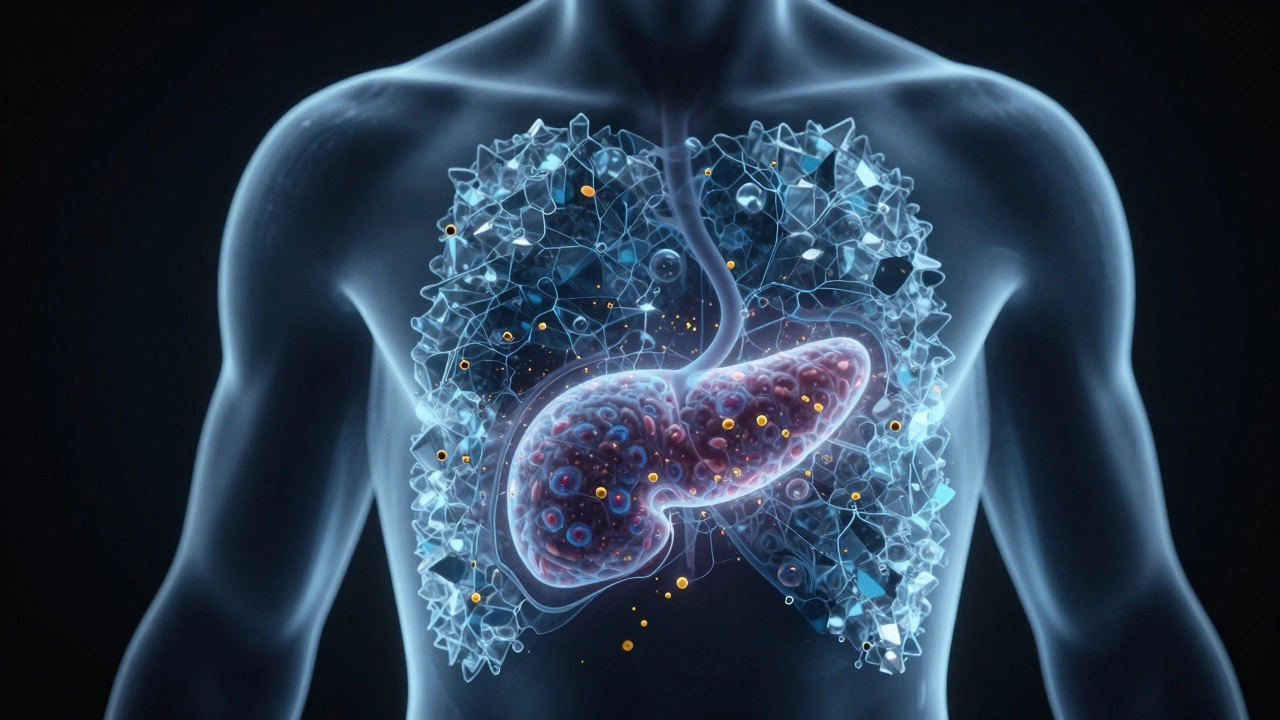
Aggressive Cancer Comparison Tool
Select a cancer type below to explore why these specific malignancies are considered highly aggressive and the unique barriers they present to modern medicine.
Pancreatic Cancer
Glioblastoma (GBM)
Small Cell Lung Cancer (SCLC)
Mesothelioma
The Dreaded Reputation of Pancreatic Cancer
If you ask a group of doctors which malignancy keeps them up at night, many will point to Pancreatic Cancer is a highly aggressive cancer that starts in the tissues of the pancreas, often specifically in the exocrine cells. It is widely considered the most feared because of its 'silent' nature. By the time a person feels a dull ache in their back or notices jaundice (yellowing of the skin), the cancer has often already reached the surrounding lymph nodes or the liver.
The real nightmare here is the biology. The pancreas is tucked deep in the abdomen, making it nearly impossible to feel a tumor during a routine physical. Furthermore, the tumor creates a dense 'stroma'-a thick wall of connective tissue-that acts like a fortress, blocking chemotherapy drugs from actually reaching the cancer cells. This is why the five-year survival rate for pancreatic cancer has historically remained stubbornly low, often hovering around 11% depending on the stage at diagnosis.
Imagine a patient who feels a bit tired and loses a few pounds, thinking it's just stress. By the time they get a CT scan, they find a mass that cannot be surgically removed. That unpredictability is where the deep-seated fear comes from.
Glioblastoma: The Battle for the Brain
While pancreatic cancer dominates the conversation about fear, Glioblastoma is a different kind of terror. Glioblastoma, or Glioblastoma Multiforme (GBM), is a fast-growing, grade IV astrocytoma that forms in the brain. It doesn't just grow as a single lump; it sends out microscopic 'tentacles' into healthy brain tissue, making complete surgical removal virtually impossible.
The fear surrounding GBM is tied to the loss of self. Because it attacks the brain, it doesn't just threaten your life-it threatens your personality, your memory, and your ability to speak. A person might wake up one day with a headache and within weeks lose the ability to recognize their own children. The standard treatment, known as the Stupp Protocol, involves a combination of surgery, radiation, and a chemotherapy drug called Temozolomide, but the recurrence rate is nearly 100%.
| Cancer Type | Primary Challenge | Typical Detection Method | Key Attribute |
|---|---|---|---|
| Pancreatic | Late-stage detection | Imaging/Biopsy | Drug-resistant stroma |
| Glioblastoma | Invasive growth patterns | MRI | Blood-brain barrier |
| Small Cell Lung Cancer | Rapid metastasis | Chest X-ray/CT | Highly aggressive growth |
| Mesothelioma | Long latency period | CT/Biopsy | Asbestos-related |
The Speed of Small Cell Lung Cancer
When we talk about fear, we have to talk about speed. Small Cell Lung Cancer (SCLC) is a type of neuroendocrine tumor that accounts for about 15% of lung cancers. Unlike Non-Small Cell Lung Cancer, which grows slowly, SCLC is like a wildfire. It can double in size in a matter of weeks and spreads to the brain and liver with alarming efficiency.
The paradox of SCLC is that it often responds incredibly well to the first round of chemotherapy. Patients see their tumors shrink rapidly, giving them a surge of hope. However, this is often a 'false spring' because SCLC almost always develops a resistance to the drugs, returning more aggressively than before. This emotional rollercoaster-from sudden hope to sudden collapse-adds a psychological layer of fear that other cancers don't have.
Mesothelioma: The Hidden Danger
Fear can also be tied to the feeling of betrayal. Mesothelioma is a rare and aggressive cancer of the lining of the lungs (pleura) or abdomen (peritoneum). What makes it terrifying is the latency period. You could have been exposed to asbestos in a construction job 30 years ago, felt perfectly healthy for decades, and suddenly develop a terminal illness in your 60s.
Because it is so rare, many general practitioners might miss the early signs, mistaking chest pain for heart issues or asthma. By the time a specialist identifies it, the pleural lining is often thickened and encased, making it incredibly painful. The treatment often involves a grueling combination of chemotherapy and surgery, or the implantation of a chemically soaked wafer during surgery to kill remaining cells.
Why We Fear These More Than Others
You might wonder why people aren't as 'afraid' of breast or prostate cancer, which are far more common. It comes down to the survival rate and the 'predictability' of the disease. For breast cancer, we have mammograms for early detection and highly targeted hormone therapies. There is a map for the journey.
The 'most feared' cancers share common traits: they lack an effective screening test, they are biologically 'smart' (they evolve to evade the immune system), and they affect critical organs. When a cancer attacks the brain or the pancreas, it disrupts the fundamental machinery of life. The fear is not just of death, but of the loss of quality of life and the feeling of helplessness against an invisible enemy.
The Shift Toward Hope: New Frontiers in Treatment
Despite the grim statistics, the landscape of 2026 is different than it was ten years ago. We are moving away from 'carpet-bombing' the body with chemo and toward 'precision strikes.' Immunotherapy is the biggest game-changer. This is a treatment that trains the patient's own immune system to recognize and attack cancer cells by removing the 'cloaking' mechanism the tumors use to hide.
Another breakthrough is CAR T-cell Therapy, where T-cells are extracted from the blood, genetically engineered in a lab to fight a specific protein on the cancer cell, and then infused back into the patient. While this has worked wonders for blood cancers, researchers are now applying these techniques to solid tumors like glioblastoma and pancreatic cancer.
We are also seeing the rise of liquid biopsies. Instead of cutting into an organ to get a piece of tissue, doctors can now detect circulating tumor DNA (ctDNA) in a simple blood draw. This could eventually end the 'silent' nature of pancreatic cancer, catching it when it is still small enough to be surgically cured.
Which cancer has the lowest survival rate?
Statistically, pancreatic cancer often has the lowest overall five-year survival rate, though this varies by stage. Glioblastoma also has very poor long-term outcomes due to the difficulty of removing all cancerous cells from the brain.
Can pancreatic cancer be cured?
Yes, but it depends heavily on timing. If the tumor is caught early and is localized to the pancreas, surgical removal (like the Whipple procedure) combined with chemotherapy can lead to long-term remission.
What are the early warning signs of the most aggressive cancers?
For pancreatic cancer, look for unexplained weight loss, new-onset diabetes in adults, and jaundice. For brain tumors, sudden changes in personality, severe headaches that wake you up at night, or new seizures are red flags.
Is immunotherapy better than chemotherapy?
It's not necessarily 'better' but 'different.' Chemotherapy kills all rapidly dividing cells, which is why it causes hair loss. Immunotherapy only targets cancer cells by activating the immune system, often resulting in fewer systemic side effects but requiring specific genetic markers in the tumor to work.
Why is glioblastoma so hard to treat?
The blood-brain barrier prevents many drugs from entering the brain. Additionally, GBM is highly heterogeneous, meaning different parts of the same tumor have different genetic mutations, making it a moving target for medication.
What to Do if You're Facing a Difficult Diagnosis
If you or a loved one are dealing with one of these aggressive cancers, the most important step is seeking a multidisciplinary team. Don't just see one oncologist; find a center that combines surgeons, radiologists, and medical oncologists who specialize in that specific cancer type. A general oncologist is great, but a pancreatic specialist who performs five Whipple surgeries a week will have a different level of expertise.
Secondly, look into clinical trials. For cancers like glioblastoma, the standard of care is often outdated. Clinical trials provide access to the newest drugs-like personalized vaccines-years before they hit the general market. Many patients find that trial participation not only provides a new treatment option but also gives them a sense of agency in a situation where they feel powerless.
Finally, prioritize palliative care early. Palliative care isn't just for the end of life; it's about managing symptoms and improving quality of life while you are still fighting the disease. Managing pain and anxiety makes the aggressive treatments more tolerable and keeps the patient's spirit strong, which is a critical part of the battle.